RESOURCES — CONSTRUCTION & TRADES
Intake Intelligence for Construction & Trades
You bid the work, run the crews, and answer the phone. GateCurate is the qualification layer that runs before the first call — so the leads you chase are the ones worth chasing.
The intake problem in construction & trades
- The tire-kicker and the funded remodel look identical in your inbox — and you find out which is which on your own time, after dark.
- Estimates go out to whoever emailed loudest. The serious client waits behind three leads that were never going to sign.
- You’re the estimator, the project manager, and the intake department. Every hour spent qualifying a dead lead is an hour off a job that pays.
- Calling back faster isn’t the fix. Speed without sorting means you just reach the time-wasters first.
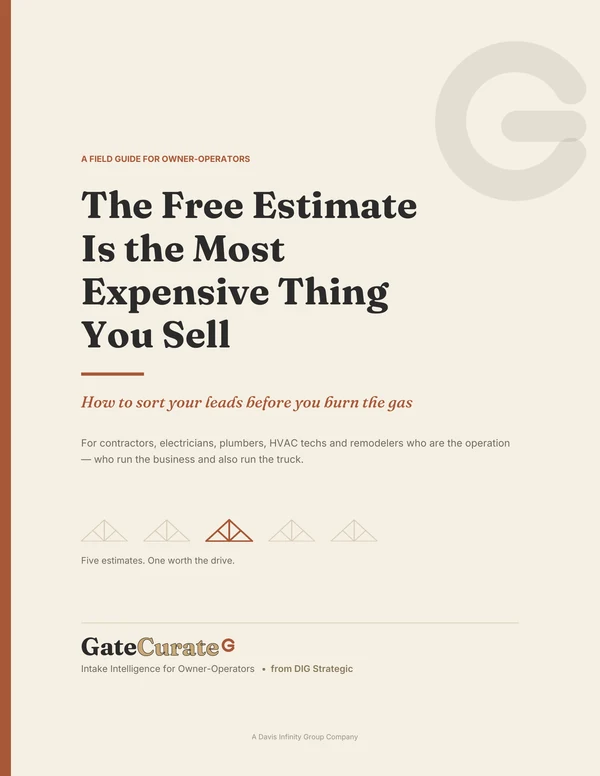
Free guide
The Free Estimate Is the Most Expensive Thing You Sell
What an estimate actually costs you, the five leads that waste your week, and the seven questions that sort them before you drive. Eleven pages, free, with a workbook you put your own numbers into.
Get the guide ↓
General contractors
The bid/no-bid call decides where your estimating hours go, and most GCs make it with nothing but a name and a phone number. Who has financing lined up? Who has stamped plans? Who’s collecting five bids to satisfy a lender? Qualification at intake puts those answers in front of you before you commit an estimator’s afternoon.
Specialty trades
Trade work comes in from two directions — GCs who need you on their schedule, and direct inquiries that run from a real emergency to someone pricing a someday project. Your inbox shows them as the same email. Sorting them at intake tells you which is which while the job is still winnable.
Field operations
When you run crews, intake happens from the truck — between site visits, at the supply house, after the last pour. You don’t need more callbacks. You need to know which callback to make first. A qualified queue puts the serious inquiry at the top and the browser at the bottom.
Start here
The Promise You Can't Keep: Why Most Contractors Lose Jobs Before They Know Whether They Can Do the Work
Most contractors ask homeowners to pick a date before knowing if they can do the work—here's why that kills jobs and what right-fit operators do instead.
June 22, 2026
Latest from Construction & Trades
The Inquiry That Arrives While You're Pouring Footings—and the Project Someone Else Wins Before You Check Your Phone
The hours between inquiry and callback are where qualified work slips away. The operator who sees intent before responding can win the project.
September 7, 2026
Poured Footings, Cold Inquiries: How Construction Projects Change Hands Before the Callback
A familiar loss for contractors: qualified work slipping away in the hours between inquiry and callback. The operator who sees intent before responding wins the project—even when they…
August 31, 2026
The Permit Window That Closes Before You Ever Get to Build
Permit timelines in major markets now stretch months—killing projects before construction begins. Learn how contractors qualify for permit readiness at intake.
August 3, 2026
The Follow-Up Gap Most Contractors Never See—and the Jobs They Lose Before the First Call
Contractors lose jobs in the hours between inquiry and callback. Learn why response time matters more than price and how to close the follow-up gap.
July 20, 2026
The First-Call Problem: Why Most Contractors Lose Jobs Before They Know What the Homeowner Actually Needs
Asking budget before you understand the project loses contractors the job. How right-fit operators sequence the first call to qualify without interrogating.
July 6, 2026
The Material-Cost Trap: Why Most Contractors Lose Jobs When They Promise a Price Before They Know What the Work Actually Costs
When a homeowner asks what the job will cost and you give them a number before you've seen the site or checked current material prices, you're not quoting the…
June 29, 2026
The Promise You Can't Keep: Why Most Contractors Lose Jobs Before They Know Whether They Can Do the Work
Most contractors ask homeowners to pick a date before knowing if they can do the work—here's why that kills jobs and what right-fit operators do instead.
June 22, 2026
The Contact-Info Moment: Why Most Contractors Lose Jobs Before They Ever Ask the First Question
Most contractors lose jobs the moment they ask for contact info—before trust exists, the ask feels like pressure and homeowners disappear mid-conversation.
June 8, 2026
The Four-Question Gap: Why Contractors Lose Jobs Before They Ever Qualify Them
Most contractors don't lose jobs on price or timeline. They lose them in the first ninety seconds, when they ask too many questions — or none at all.
June 1, 2026
The One Question That Determines Which Leads Are Worth Your Time
Every contractor knows the moment a lead comes in is the moment the clock starts ticking — but most don't know the one question that tells you, in the first sixty seconds, whether this job is real or
May 25, 2026
The Hidden Cost of Manual Lead Triage in General Contracting
Every contractor knows the cost of the wrong job. Almost none of them track the cost of figuring out which job is the wrong one — and that's where the real money is leaking.
May 18, 2026
Why Your Best Estimator Is Buried in Junk Leads
The most expensive person on your crew is spending half their week on jobs that were never going to close. Here's where the time goes — and what to do about it.
May 11, 2026
How Contractors Lose Leads Without an Intake System
Every contractor knows the feeling of a hot lead going cold by Tuesday. What most don't see is that the loss happens upstream — long before the callback — in the silent gap between when someone fills
May 4, 2026
Questions operators ask
What does GateCurate cost for a construction operation?
Signal is $149/month for one seat and 40 scored inquiries, Operator is $399/month for three seats and 250 scored inquiries, and Team is $799/month for seven seats and unlimited scored inquiries. Every tier gets the same intake forms, scoring logic, and webhooks — no feature gating. For most GCs and trade owners handling their own inbound, Signal is the right starting point until callbacks outgrow one person.
How quickly can a construction crew be up and running?
The fit check takes about two minutes. Checkout is immediate, and onboarding lands by email the same day. You can drop a GateCurate intake form onto your existing estimates page, contact page, or ad landing page without waiting on a developer — the qualification layer is live before the next job call comes in.
We’re a small crew. Which plan fits?
Signal at $149/month is built for the operator who answers the phone and walks the site. One seat, 40 scored inquiries a month, and unlimited intake forms. When your volume outgrows one person — or when you bring on an office manager or estimator — Operator adds seats and volume without moving you to a different product.
FREE GUIDE
The Free Estimate Is the Most Expensive Thing You Sell
11 pages on what an estimate actually costs you, the five leads that waste your week, and the seven questions that sort them before you drive.
This is a GateCurate intake form. It's the same thing your contact form becomes. Fill it out and you've used the product.
You're inside a live GateCurate flow.
Stop qualifying leads at 9pm.
A two-minute fit check, secure checkout, and your qualification layer runs the same day. The first callback you make tomorrow can be a real one.
Activate Access